Standard ISR processing will typically involve recording the reason for the interrupt, clearing the interrupt, then performing any processing necessitated by the interrupt, all within the ISR itself.
Deferred interrupt processing will typically involve recording the reason for the interrupt and clearing the interrupt within the ISR, but then unblocking an RTOS task so the processing necessitated by the interrupt can be performed by the unblocked task, rather than within the ISR.
If the task to which interrupt processing is deferred is assigned a high enough priority then the ISR will return directly to the unblocked task (the interrupt will interrupt one task, but then return to a different task), resulting in all the processing necessitated by the interrupt being performed contiguously in time (without a gap), just as if all the processing had been performed in the ISR itself. This can be see in the image below, where all the interrupt processing occurs between times t2 and t4, even though part of the processing is performed by a task.
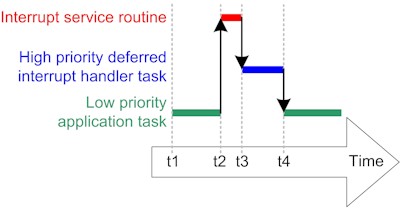
Deferred interrupt processing execution sequence when the
deferred handling task has a high priority
With reference to the image above:
- At time t2: A low priority task is pre-empted by an interrupt.
- At time t3: The ISR returns directly to a task that was unblocked from within the ISR. The majority of interrupt processing is performed within the unblocked task.
- At time t4: The task that was unblocked by the ISR returns to the Blocked state to wait for the next interrupt, allowing the lower priority application task to continue its execution.