FreeRTOS Queues
[See also Blocking on Multiple RTOS Objects]
Queues are the primary form of intertask communications. They can be used to send messages between tasks, and between interrupts and tasks.
In most cases they are used as thread safe FIFO (First In First Out) buffers with new data being sent to the back of the queue, although
data can also be sent to the front.
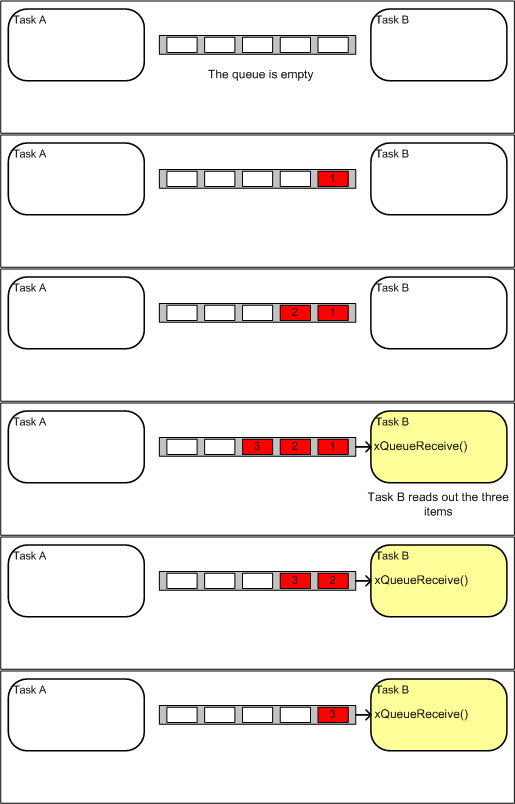 Writing to and reading from a queue. In this example the queue was created to hold 5 items, and the
queue never becomes full.
Writing to and reading from a queue. In this example the queue was created to hold 5 items, and the
queue never becomes full.
User Model: Maximum Simplicity, Maximum Flexibility . . .
The FreeRTOS queue usage model manages to combine simplicity with flexibility - attributes
that are normally mutually exclusive. Messages are sent through queues by copy, meaning
the data (which can be a pointer to larger buffers) is itself copied into the queue rather than the
queue always storing just a reference to the data. This is the best approach because:
-
Small messages that are already contained in C variables (integers,
small structures, etc.) can be sent into a queue directly. There is no
need to allocate a buffer for the message and then copy the variable into
the allocated buffer. Likewise, messages can be read from queues directly
into C variables.
Further, sending to a queue in this way allows the sending task
to immediately overwrite the variable or buffer that was sent to the queue,
even when the sent message remains in the queue.
Because the data contained in the variable was copied into the queue the
variable itself is available for
re-use. There is no requirement for the task that sends the message and
the task that receives the message to agree which task owns the message,
and which task is responsible for freeing the message when it is no
longer required.
-
Using queues that pass data by copy does not prevent queues from being
used to pass data by reference. When the size of a message reaches a point
where it is not practical to copy the entire message into the queue byte
for byte, define the queue
to hold pointers and copy just a pointer to the message into the queue
instead.
This is exactly how the
FreeRTOS+UDP
implementation passes large network buffers around the FreeRTOS IP stack.
-
The kernel takes complete responsibility for allocating the memory used
as the queue storage area.
-
Variable sized messages can be sent by defining queues to hold structures
that contain a member that points to the queued message, and another
member that holds the size of the queued message.
-
A single queue can be used to receive different message types, and messages
from multiple locations, by defining the queue to hold a structure that
has a member that holds the message type, and another member that holds
the message data (or a pointer to the message data). How the data is
interpreted depends on the message type.
This is exactly how the task that manages the
FreeRTOS+UDP
IP stack is able to use a single queue to receive notifications of ARP timer events, packets
being received from the Ethernet hardware, packets being received from
the application, network down events, etc.
-
The implementation is naturally suited for use in a memory protected
environment. A task that is restricted to a protected memory area can
pass data to a task that is restricted to a different protected memory
area because invoking the RTOS by calling the queue send function will
raise the microcontroller privilege level. The queue storage area is
only accessed by the RTOS (with full privileges).
-
A separate API is provided for use inside of an interrupt. Separating
the API used from an RTOS task from that used from an interrupt service
routine means the implementation of the RTOS API functions do not carry
the overhead of checking their call context each time they execute.
Using a separate interrupt API also means, in most cases, creating RTOS
aware interrupt service routines is simpler for end users than when
compared to alternative RTOS products.
-
In every way, the API is simpler.
The FreeRTOS tutorial book
provides additional information on queues, binary semaphores, mutexes, counting
semaphores and recursive semaphores, along with simple worked examples in a set of accompanying example projects.
Blocking on Queues
Queue API functions permit a block time to be specified.
When a task attempts to read from an empty queue the task will be placed into
the Blocked state (so it is not consuming any CPU time and other tasks can run)
until either data becomes available on the queue, or the block time expires.
When a task attempts to write to a full queue the task will be placed into
the Blocked state (so it is not consuming any CPU time and other tasks can run)
until either space becomes available in the queue, or the block time expires.
If more than one task block on the same queue then the task with the highest
priority will be the task that is unblocked first.
See the Queue Management section of the user documentation for a list of queue related API
functions. Searching the files in the FreeRTOS/Demo/Common/Minimal directory will reveal multiple examples of their usage.
Note that interrupts must NOT use API functions that do not end in "FromISR".