|
|
|
| Renesas RL78 promotion and starter kits | |
This page documents an application that demonstrates the use of FreeRTOS on
a Renesas RL78 16-bit microcontroller.
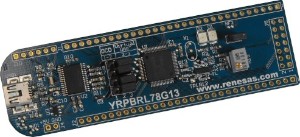
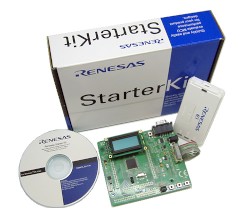
The demo includes five separate build configurations, one for each of the following device evaluation boards:
Note: The project described on this page requires IAR Embedded Workbench for the RL78 (EWRL78) version 1.30.2 or higher. A free evaluation edition of EWRL78 is available for download from the IAR web site.
If this project fails to build then it is likely the version of IAR Embedded Workbench being used is too old. Opening an IAR project in a version of EWRL78 that is older than the version used to create the project will often (silently) corrupt the project file, necessitating that a clean copy of the project is restored from the FreeRTOS zip file download before proceeding with an updated compiler.
See also the FAQ My application does not run, what could be wrong?
See the Source Code Organization section for a description of the downloaded files and information on creating a new project.
The IAR Embedded Workbench workspace for the Renesas RL78 project is called RTOSDemo.eww, and is located in the FreeRTOS\Demo\RL78_multiple_IAR directory.
The queue send task is implemented by the prvQueueSendTask() function in main_blinky.c.
prvQueueSendTask() sits in a loop that causes it to repeatedly block for 200 milliseconds, before sending the value 100 to the queue that was created within main_blinky(). Once the value is sent, the task loops back around to block for another 200 milliseconds, and so on.
The queue receive task is implemented by the prvQueueReceiveTask() function in main_blinky.c.
prvQueueReceiveTask() sits in a loop where it repeatedly blocks on attempts to read data from the queue that was created within main_blinky(), toggling an LED each time the value 100 is received.
The queue receive task will only leave the Blocked state when the queue send task writes to the queue. As the queue send task writes to the queue every 200 milliseconds, the queue receive task leaves the Blocked state and toggles the LED every 200 milliseconds.
The following tasks and timers are created in addition to the standard demo tasks.
These fill the registers with known values, then check that each register still contains its expected value. Each task uses a different set of values. The reg test tasks execute with a very low priority, so get preempted very frequently. A register containing an unexpected value is indicative of an error in the context switching mechanism.
The demo software timer callback function does nothing more than increment a variable. The period of the demo timer is set relative to the period of the check timer (described below). This allows the check timer to know how many times the demo timer callback function should execute between each execution of the check timer callback function. The variable incremented in the demo timer callback function is used to determine how many times the callback function has executed.
The check software timer period is initially set to three seconds. The check timer callback function checks that all the standard demo tasks, the reg test tasks, and the demo timer are not only still executing, but are executing without reporting any errors. If the check timer discovers that a task or timer has stalled, or reported an error, then it changes its own period from the initial three seconds, to just 200ms.
The check timer callback function also toggles an LED each time it is called. This provides a visual indication of the system status: If the LED toggles every three seconds, then no issues have been discovered. If the LED toggles every 200ms, then an issue has been discovered with at least one task.
Each port #defines 'BaseType_t' to equal the most efficient data type for that processor. This port defines BaseType_t to be of type short.
Note that vPortEndScheduler() has not been implemented.
Often you will require an interrupt service routine to cause a context switch. For example a serial port character being received may unblock a high priority task that was blocked waiting for the character to arrive. If the unblocked task has a higher priority than the current task (the task that was interrupted by the ISR), then the ISR should return directly to the unblocked task. The use of the IAR tools necessitates such interrupt service routines are entered using an assembly file wrapper. An example is provided below, and another example is provided in main.c. First the assembly file wrapper.
; ISR_Support.h defines the portSAVE_CONTEXT and portRESTORE_CONTEXT
; macros.
#include "ISR_Support.h"

    ; The wrapped implemented in the assembly file.
    PUBLIC    vISRWrapper

    ; The portion of the handler that is implemented in an external C file.
    EXTERN    vISRHandler

    ; Ensure the code segment is used.
    RSEG CODE:CODE

; The wrapper is the interrupt entry point.
vISRWrapper:

    ; The ISR must start with a call to the portSAVE_CONTEXT() macro to save
    ; the context of the currently running task.
    portSAVE_CONTEXT

    ; Once the context is saved the C portion of the handler can be called.
    ; This is where the interrupting peripheral is actually serviced.
    call vISRHandler

    ; Finally the ISR must end with a call to portRESTORE_CONTEXT() followed by
    ; a reti instruction to return from the interrupt to whichever task is
    ; now the task selected to run (which may be different to the task that
    ; was running before the interrupt started).
    portRESTORE_CONTEXT
    reti


    ; The interrupt handler can be installed into the vector table in the same
    ;assembly file.

    ; Ensure the vector table segment is used.
    COMMON INTVEC:CODE:ROOT(1)

    ; Place a pointer to the asm wrapper at the correct index into the vector
    ; table.  Note 56 is used is purely as an example.  The correct vector
    ; number for the interrupt being installed must be used.
    ORG 56
    DW vISRWrapper
The C portion of the interrupt handler is just a standard C function.
/* This standard C function is called from the assembly wrapper above. */
void vISRHandler( void )
{
short sHigherPriorityTaskWoken = pdFALSE;

    /* Handler code goes here, for purposes of demonstration, assume
    at some point the hander calls xSemaphoreGiveFromISR().*/
    xSemaphoreGiveFromISR( xSemaphore, &sHigherPriorityTaskWoken );

    /* If giving the semaphore unblocked a task, and the unblocked task has a
    priority that is higher than the currently running task, then
    sHigherPriorityTaskWoken will have been set to pdTRUE.  Passing a pdTRUE
    value to portYIELD_FROM_ISR() will cause this interrupt to return directly
    to the higher priority unblocked task. */
    portYIELD_FROM_ISR( sHigherPriorityTaskWoken );
}
#define configSETUP_TICK_INTERRUPT() MyTimerSetup()NOTE: vPortTickISR() must be installed as the handler for which ever interrupt is used to generate the RTOS tick.
The RTOS kernel also requires exclusive use of the BRK software interrupt instruction.