
Each demo application included in the RTOS source code download has its own FreeRTOSConfig.h file. Some of the demos are quite old and do not contain all the available configuration options. Configuration options that are omitted are set to a default value within an RTOS source file.
Here is a typical FreeRTOSConfig.h definition, followed by an explanation of each parameter:
#ifndef FREERTOS_CONFIG_H
#define FREERTOS_CONFIG_H

/* Here is a good place to include header files that are required across
your application. */
#include "something.h"

#define configUSE_PREEMPTION                    1
#define configUSE_PORT_OPTIMISED_TASK_SELECTION 0
#define configUSE_TICKLESS_IDLE                 0
#define configCPU_CLOCK_HZ                      60000000
#define configTICK_RATE_HZ                      250
#define configMAX_PRIORITIES                    5
#define configMINIMAL_STACK_SIZE                128
#define configMAX_TASK_NAME_LEN                 16
#define configUSE_16_BIT_TICKS                  0
#define configIDLE_SHOULD_YIELD                 1
#define configUSE_TASK_NOTIFICATIONS            1
#define configUSE_MUTEXES                       0
#define configUSE_RECURSIVE_MUTEXES             0
#define configUSE_COUNTING_SEMAPHORES           0
#define configUSE_ALTERNATIVE_API               0 /* Deprecated! */
#define configQUEUE_REGISTRY_SIZE               10
#define configUSE_QUEUE_SETS                    0
#define configUSE_TIME_SLICING                  0
#define configUSE_NEWLIB_REENTRANT              0
#define configENABLE_BACKWARD_COMPATIBILITY     0
#define configNUM_THREAD_LOCAL_STORAGE_POINTERS 5

/* Memory allocation related definitions. */
#define configSUPPORT_STATIC_ALLOCATION         1
#define configSUPPORT_DYNAMIC_ALLOCATION        1
#define configTOTAL_HEAP_SIZE                   10240
#define configAPPLICATION_ALLOCATED_HEAP        1

/* Hook function related definitions. */
#define configUSE_IDLE_HOOK                     0
#define configUSE_TICK_HOOK                     0
#define configCHECK_FOR_STACK_OVERFLOW          0
#define configUSE_MALLOC_FAILED_HOOK            0
#define configUSE_DAEMON_TASK_STARTUP_HOOK      0

/* Run time and task stats gathering related definitions. */
#define configGENERATE_RUN_TIME_STATS           0
#define configUSE_TRACE_FACILITY                0
#define configUSE_STATS_FORMATTING_FUNCTIONS    0

/* Co-routine related definitions. */
#define configUSE_CO_ROUTINES                   0
#define configMAX_CO_ROUTINE_PRIORITIES         1

/* Software timer related definitions. */
#define configUSE_TIMERS                        1
#define configTIMER_TASK_PRIORITY               3
#define configTIMER_QUEUE_LENGTH                10
#define configTIMER_TASK_STACK_DEPTH            configMINIMAL_STACK_SIZE

/* Interrupt nesting behaviour configuration. */
#define configKERNEL_INTERRUPT_PRIORITY         [dependent of processor]
#define configMAX_SYSCALL_INTERRUPT_PRIORITY    [dependent on processor and application]
#define configMAX_API_CALL_INTERRUPT_PRIORITY   [dependent on processor and application]

/* Define to trap errors during development. */
#define configASSERT( ( x ) ) if( ( x ) == 0 ) vAssertCalled( __FILE__, __LINE__ )

/* FreeRTOS MPU specific definitions. */
#define configINCLUDE_APPLICATION_DEFINED_PRIVILEGED_FUNCTIONS 0

/* Optional functions - most linkers will remove unused functions anyway. */
#define INCLUDE_vTaskPrioritySet                1
#define INCLUDE_uxTaskPriorityGet               1
#define INCLUDE_vTaskDelete                     1
#define INCLUDE_vTaskSuspend                    1
#define INCLUDE_xResumeFromISR                  1
#define INCLUDE_vTaskDelayUntil                 1
#define INCLUDE_vTaskDelay                      1
#define INCLUDE_xTaskGetSchedulerState          1
#define INCLUDE_xTaskGetCurrentTaskHandle       1
#define INCLUDE_uxTaskGetStackHighWaterMark     0
#define INCLUDE_xTaskGetIdleTaskHandle          0
#define INCLUDE_eTaskGetState                   0
#define INCLUDE_xEventGroupSetBitFromISR        1
#define INCLUDE_xTimerPendFunctionCall          0
#define INCLUDE_xTaskAbortDelay                 0
#define INCLUDE_xTaskGetHandle                  0
#define INCLUDE_xTaskResumeFromISR              1

/* A header file that defines trace macro can be included here. */

#endif /* FREERTOS_CONFIG_H */
The Generic method:
A port specific method:
The malloc() failed hook function is a hook (or callback) function that, if defined and configured, will be called if pvPortMalloc() ever returns NULL. NULL will be returned only if there is insufficient FreeRTOS heap memory remaining for the requested allocation to succeed.
If configUSE_MALLOC_FAILED_HOOK is set to 1 then the application must define a malloc() failed hook function. If configUSE_MALLOC_FAILED_HOOK is set to 0 then the malloc() failed hook function will not be called, even if one is defined. Malloc() failed hook functions must have the name and prototype shown below.
void vApplicationMallocFailedHook( void );
void void vApplicationDaemonTaskStartupHook( void );
The tick interrupt is used to measure time. Therefore a higher tick frequency means time can be measured to a higher resolution. However, a high tick frequency also means that the RTOS kernel will use more CPU time so be less efficient. The RTOS demo applications all use a tick rate of 1000Hz. This is used to test the RTOS kernel and is higher than would normally be required.
More than one task can share the same priority. The RTOS scheduler will share processor time between tasks of the same priority by switching between the tasks during each RTOS tick. A high tick rate frequency will therefore also have the effect of reducing the 'time slice' given to each task.
Each available priority consumes RAM within the RTOS kernel so this value should not be set any higher than actually required by your application.
Like the stack size parameter to the xTaskCreate() and xTaskCreateStatic() functions, the stack size is specified in words, not bytes. If each item placed on the stack is 32-bits, then a stack size of 100 means 400 bytes (each 32-bit stack item consuming 4 bytes).
Defining configUSE_16_BIT_TICKS as 1 causes TickType_t to be defined (typedef'ed) as an unsigned 16bit type. Defining configUSE_16_BIT_TICKS as 0 causes TickType_t to be defined (typedef'ed) as an unsigned 32bit type.
Using a 16 bit type will greatly improve performance on 8 and 16 bit architectures, but limits the maximum specifiable time period to 65535 'ticks'. Therefore, assuming a tick frequency of 250Hz, the maximum time a task can delay or block when a 16bit counter is used is 262 seconds, compared to 17179869 seconds when using a 32bit counter.
When tasks share the idle priority the behaviour can be slightly different. If configIDLE_SHOULD_YIELD is set to 1 then the idle task will yield immediately if any other task at the idle priority is ready to run. This ensures the minimum amount of time is spent in the idle task when application tasks are available for scheduling. This behaviour can however have undesirable effects (depending on the needs of your application) as depicted below:
The diagram above shows the execution pattern of four tasks that are all running at the idle priority. Tasks A, B and C are application tasks. Task I is the idle task. A context switch occurs with regular period at times T0, T1, ..., T6. When the idle task yields task A starts to execute - but the idle task has already consumed some of the current time slice. This results in task I and task A effectively sharing the same time slice. The application tasks B and C therefore get more processing time than the application task A.
This situation can be avoided by:
Setting configUSE_TASK_NOTIFICATIONS to 0 will exclude direct to task notification functionality and its associated API from the build.
Each task consumes 8 additional bytes of RAM when direct to task notifications are included in the build.
configQUEUE_REGISTRY_SIZE defines the maximum number of queues and semaphores that can be registered. Only those queues and semaphores that you want to view using a RTOS kernel aware debugger need be registered. See the API reference documentation for vQueueAddToRegistry() and vQueueUnregisterQueue() for more information.
Note Newlib support has been included by popular demand, but is not used by the FreeRTOS maintainers themselves. FreeRTOS is not responsible for resulting newlib operation. User must be familiar with newlib and must provide system-wide implementations of the necessary stubs. Be warned that (at the time of writing) the current newlib design implements a system-wide malloc() that must be provided with locks.
If configSUPPORT_STATIC_ALLOCATION is set to 0 then RTOS objects can only be created using RAM allocated from the FreeRTOS heap.
If configSUPPORT_STATIC_ALLOCATION is left undefined it will default to 0.
If configSUPPORT_STATIC_ALLOCATION
is set to 1 then the application writer must also provide two callback functions:
vApplicationGetIdleTaskMemory() to provide the memory for use by
the RTOS Idle task, and (if configUSE_TIMERS is set to 1) vApplicationGetTimerTaskMemory() to
provide memory for use by the RTOS Daemon/Timer Service task. Examples are
provided below.
/* configSUPPORT_STATIC_ALLOCATION is set to 1, so the application must provide an
implementation of vApplicationGetIdleTaskMemory() to provide the memory that is
used by the Idle task. */
void vApplicationGetIdleTaskMemory( StaticTask_t **ppxIdleTaskTCBBuffer,
StackType_t **ppxIdleTaskStackBuffer,
uint32_t *pulIdleTaskStackSize )
{
/* If the buffers to be provided to the Idle task are declared inside this
function then they must be declared static - otherwise they will be allocated on
the stack and so not exists after this function exits. */
static StaticTask_t xIdleTaskTCB;
static StackType_t uxIdleTaskStack[ configMINIMAL_STACK_SIZE ];
/* Pass out a pointer to the StaticTask_t structure in which the Idle task's
state will be stored. */
*ppxIdleTaskTCBBuffer = &xIdleTaskTCB;
/* Pass out the array that will be used as the Idle task's stack. */
*ppxIdleTaskStackBuffer = uxIdleTaskStack;
/* Pass out the size of the array pointed to by *ppxIdleTaskStackBuffer.
Note that, as the array is necessarily of type StackType_t,
configMINIMAL_STACK_SIZE is specified in words, not bytes. */
*pulIdleTaskStackSize = configMINIMAL_STACK_SIZE;
}
/*-----------------------------------------------------------*/
/* configSUPPORT_STATIC_ALLOCATION and configUSE_TIMERS are both set to 1, so the
application must provide an implementation of vApplicationGetTimerTaskMemory()
to provide the memory that is used by the Timer service task. */
void vApplicationGetTimerTaskMemory( StaticTask_t **ppxTimerTaskTCBBuffer,
StackType_t **ppxTimerTaskStackBuffer,
uint32_t *pulTimerTaskStackSize )
{
/* If the buffers to be provided to the Timer task are declared inside this
function then they must be declared static - otherwise they will be allocated on
the stack and so not exists after this function exits. */
static StaticTask_t xTimerTaskTCB;
static StackType_t uxTimerTaskStack[ configTIMER_TASK_STACK_DEPTH ];
/* Pass out a pointer to the StaticTask_t structure in which the Timer
task's state will be stored. */
*ppxTimerTaskTCBBuffer = &xTimerTaskTCB;
/* Pass out the array that will be used as the Timer task's stack. */
*ppxTimerTaskStackBuffer = uxTimerTaskStack;
/* Pass out the size of the array pointed to by *ppxTimerTaskStackBuffer.
Note that, as the array is necessarily of type StackType_t,
configTIMER_TASK_STACK_DEPTH is specified in words, not bytes. */
*pulTimerTaskStackSize = configTIMER_TASK_STACK_DEPTH;
}
Examples of the callback functions that must be provided by the application to
supply the RAM used by the Idle and Timer Service tasks if configSUPPORT_STATIC_ALLOCATION
is set to 1.
See the Static Vs Dynamic Memory Allocation
page for more information.
If configSUPPORT_DYNAMIC_ALLOCATION is set to 0 then RTOS objects can only be created using RAM provided by the application writer.
If configSUPPORT_DYNAMIC_ALLOCATION is left undefined it will default to 1.
See the Static Vs Dynamic Memory Allocation page for more information.
This value will only be used if configSUPPORT_DYNAMIC_ALLOCATION is set to 1 and the application makes use of one of the sample memory allocation schemes provided in the FreeRTOS source code download. See the memory configuration section for further details.
If heap_1.c, heap_2.c or heap_4.c is used, and configAPPLICATION_ALLOCATED_HEAP is set to 1, then the application writer must provide a uint8_t array with the exact name and dimension as shown below. The array will be used as the FreeRTOS heap. How the array is placed at a specific memory location is dependent on the compiler being used - refer to your compiler's documentation.
uint8_t ucHeap[ configTOTAL_HEAP_SIZE ];
configKERNEL_INTERRUPT_PRIORITY
Ports that contain a configKERNEL_INTERRUPT_PRIORITY setting include ARM Cortex-M3, PIC24, dsPIC, PIC32, SuperH and RX600.
Ports that contain a configMAX_SYSCALL_INTERRUPT_PRIORITY setting include PIC32, RX600, ARM Cortex-A and ARM Cortex-M ports.
configMAX_SYSCALL_INTERRUPT_PRIORITY and
configMAX_API_CALL_INTERRUPT_PRIORITY
ARM Cortex-M3 and ARM Cortex-M4 users please take heed of the special note at the end of this section!
configMAX_API_CALL_INTERRUPT_PRIORITY is a new name for configMAX_SYSCALL_INTERRUPT_PRIORITY that is used by newer ports only. The two are equivalent.
configKERNEL_INTERRUPT_PRIORITY should be set to the lowest priority.
Note in the following discussion that only API functions that end in "FromISR" can be called from within an interrupt service routine.
For ports that only implement configKERNEL_INTERRUPT_PRIORITY
configKERNEL_INTERRUPT_PRIORITY sets the interrupt priority used by the RTOS kernel itself. Interrupts that call API functions must also execute at this
priority. Interrupts that do not call API functions can execute at higher priorities and therefore never have their execution delayed by the RTOS kernel
activity (within the limits of the hardware itself).
For ports that implement both configKERNEL_INTERRUPT_PRIORITY and configMAX_SYSCALL_INTERRUPT_PRIORITY:
configKERNEL_INTERRUPT_PRIORITY sets the interrupt priority used by the RTOS kernel itself. configMAX_SYSCALL_INTERRUPT_PRIORITY sets the highest
interrupt priority from which interrupt safe FreeRTOS API functions can be called.
A full interrupt nesting model is achieved by setting configMAX_SYSCALL_INTERRUPT_PRIORITY above (that is, at a higher priority level) than configKERNEL_INTERRUPT_PRIORITY. This means the FreeRTOS kernel does not completely disable interrupts, even inside critical sections. Further, this is achieved without the disadvantages of a segmented kernel architecture. Note however, certain microcontroller architectures will (in hardware) disable interrupts when a new interrupt is accepted - meaning interrupts are unavoidably disabled for the short period between the hardware accepting the interrupt, and the FreeRTOS code re-enabling interrupts.
Interrupts that do not call API functions can execute at priorities above configMAX_SYSCALL_INTERRUPT_PRIORITY and therefore never be delayed by the RTOS kernel execution.
For example, imagine a hypothetical microcontroller that has 8 interrupt priority levels - 0 being the lowest and 7 being the highest (see the special note for ARM Cortex-M3 users at the end of this section). The picture below describes what can and cannot be done at each priority level should the two configuration constants be set to 4 and 0 as shown:
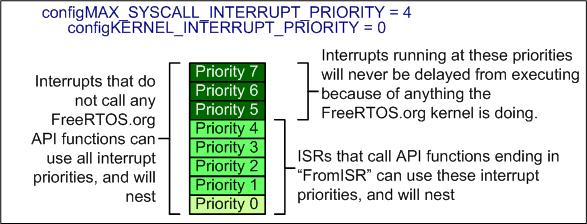
These configuration parameters allow very flexible interrupt handling:
A special note for ARM Cortex-M3 and ARM Cortex-M4 users: Please read the page dedicated to interrupt priority settings on ARM Cortex-M devices. As a minimum, remember that ARM Cortex-M3 cores use numerically low priority numbers to represent HIGH priority interrupts, which can seem counter-intuitive and is easy to forget! If you wish to assign an interrupt a low priority do NOT assign it a priority of 0 (or other low numeric value) as this can result in the interrupt actually having the highest priority in the system - and therefore potentially make your system crash if this priority is above configMAX_SYSCALL_INTERRUPT_PRIORITY.
The lowest priority on a ARM Cortex-M3 core is in fact 255 - however different ARM Cortex-M3 vendors implement a different number of priority bits and supply library functions that expect priorities to be specified in different ways. For example, on the STM32 the lowest priority you can specify in an ST driver library call is in fact 15 - and the highest priority you can specify is 0.
configASSERT() is called throughout the FreeRTOS source files to check how the application is using FreeRTOS. It is highly recommended to develop FreeRTOS applications with configASSERT() defined.
The example definition (shown at the top of the file and replicated below) calls vAssertCalled(), passing in the file name and line number of the triggering configASSERT() call (__FILE__ and __LINE__ are standard macros provided by most compilers). This is just for demonstration as vAssertCalled() is not a FreeRTOS function, configASSERT() can be defined to take whatever action the application writer deems appropriate.
It is normal to define configASSERT() in such a way that it will prevent the application from executing any further. This if for two reasons; stopping the application at the point of the assertion allows the cause of the assertion to be debugged, and executing past a triggered assertion will probably result in a crash anyway.
Note defining configASSERT() will increase both the application code size and execution time. When the application is stable the additional overhead can be removed by simply commenting out the configASSERT() definition in FreeRTOSConfig.h.
/* Define configASSERT() to call vAssertCalled() if the assertion fails.  The assertion
has failed if the value of the parameter passed into configASSERT() equals zero. */
#define configASSERT( ( x ) )     if( ( x ) == 0 ) vAssertCalled( __FILE__, __LINE__ )
If running FreeRTOS under the control of a debugger, then configASSERT() can be defined to just disable interrupts and sit in a loop, as demonstrated below. That will have the effect of stopping the code on the line that failed the assert test - pausing the debugger will then immediately take you to the offending line so you can see why it failed.
/* Define configASSERT() to disable interrupts and sit in a loop. */
#define configASSERT( ( x ) )     if( ( x ) == 0 ) { taskDISABLE_INTERRUPTS(); for( ;; ); }
If configINCLUDE_APPLICATION_DEFINED_PRIVILEGED_FUNCTIONS is set to 1 then the application writer must provide a header file called "application_defined_privileged_functions.h", in which functions the application writer needs to execute in privileged mode can be implemented. Note that, despite having a .h extension, the header file should contain the implementation of the C functions, not just the functions' prototypes.
Functions implemented in "application_defined_privileged_functions.h" must save and restore the processor's privilege state using the prvRaisePrivilege() function and portRESET_PRIVILEGE() macro respectively. For example, if a library provided print function accesses RAM that is outside of the control of the application writer, and therefore cannot be allocated to a memory protected user mode task, then the print function can be encapsulated in a privileged function using the following code:
void MPU_debug_printf( const char *pcMessage )
{
/* State the privilege level of the processor when the function was called. */
BaseType_t xRunningPrivileged = prvRaisePrivilege();

    /* Call the library function, which now has access to all RAM. */
    debug_printf( pcMessage );

    /* Reset the processor privilege level to its original value. */
    portRESET_PRIVILEGE( xRunningPrivileged );
}
This technique should only be use during development, and not deployment, as it circumvents the memory protection.
Each macro takes the form ...
To exclude vTaskDelete() from your build use: INCLUDE_FunctionName ... where FunctionName indicates the API
function (or set of functions) that can optionally be excluded. To include the API function set the macro to 1,
to exclude the function set the macro to 0. For example, to include the vTaskDelete()
API function use: #define INCLUDE_vTaskDelete 1#define INCLUDE_vTaskDelete 0