Microchip PIC32 MZ RTOS port
with a MIPS M14K core
[RTOS Ports]
Introduction
The PIC32MZ and PIC32MZ EF RTOS ports
This page presents the FreeRTOS port and demo application for the PIC32MZ
and PIC32MZ EF 32bit microcontrollers from Microchip, which have a MIPS M14K core.
The FreeRTOS PIC32MZ port:
-
Maintains a separate interrupt stack. Without a separate interrupt stack
each task stack would have to allocated enough space to hold an entire
(potentially nested) interrupt stack frame.
-
Supports interrupt stack overflow detection in addition to the standard
task stack overflow detection. Interrupt stack overflow detection is
turned on by building with
configCHECK_FOR_STACK_OVERFLOW set to 3 when
configASSERT() is also defined.
-
Provides a full interrupt nesting model that does not, itself, ever completely disable
interrupts. Although the MIPS hardware disables interrupts on entry to an
interrupt service routine the RTOS code quickly re-enables them before
any application handler code is executed.
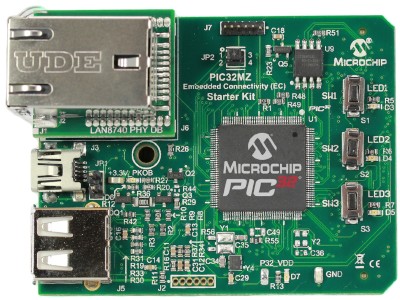
PIC32MZ Starter Kit
The demo application
The demo application is pre-configured to use the
MPLAB X IDE and the
MPLAB XC32 GCC based
compiler. Three build configurations are provided; PIC32MZ2048_SK which targets
the standard PIC32MZ Starter Kit, and PIC32MZ2048EF_SK_SOFT_FLOAT and
PIC32MZ2048EF_SK_HARD_FLOAT - both of which target the
PIC32 Embedded Connectivity with FPU (EF) Starter Kit.
The demo project can be configuration to build either a simple blinky demo or a
comprehensive test and demo application. The comprehensive application demonstrates
and tests the interrupt nesting behaviour. Build instructions are provided on this
page.
IMPORTANT! Notes on using the PIC32 MZ RTOS port
Please read all the following points before using this RTOS port.
- Source Code Organization
- The Demo Application
- Configuration and Usage Details
See also the FAQ My application does not run, what could be wrong?
Source Code Organization
The FreeRTOS download contains the source code and demo application projects for
all the RTOS ports, so most of the files it contains are not relevant to the
PIC32MZ demo.
See the Source Code Organization section for a description of the
downloaded files, and information on creating a new project.
The MPLAB X project that builds the PIC32MZ RTOS demo is located in the
FreeRTOS/Demo/PIC32MZ_MPLAB directory.
The Demo Application
Functionality
The constant mainCREATE_SIMPLE_BLINKY_DEMO_ONLY, which is defined at the
top of main.c, is used to switch between a simple 'blinky' style starter project
and a more comprehensive test and demo application.
When mainCREATE_SIMPLE_BLINKY_DEMO_ONLY is set to 1
When mainCREATE_SIMPLE_BLINKY_DEMO_ONLY is set to 1 main() calls main_blinky().
main_blinky() creates a very simple example that uses two
tasks, one queue, and one software timer.
-
The Blinky Software Timer:
This demonstrates an auto-reload software timer. The timer callback
function does nothing but toggle an LED.
-
The Queue Send Task:
The queue send task is implemented by the prvQueueSendTask() function.
The task sits in a loop that sends the value 100 to the queue
every 200 milliseconds.
-
The Queue Receive Task:
The queue receive task is implemented by the prvQueueReceiveTask()
function. The task sits in a loop blocking on attempts to
read from the queue (no CPU cycles are consumed while it is blocked),
toggling an LED each time a value is received. As the queue send task
writes to the queue very 200 milliseconds the queue receive task unblocks
and toggles the LED every 200 milliseconds.
When mainCREATE_SIMPLE_BLINKY_DEMO_ONLY is set to 0
When mainCREATE_SIMPLE_BLINKY_DEMO_ONLY is set to 0 main() calls main_full().
main_full() creates a very comprehensive test and demo application that
creates numerous RTOS tasks and software timers.
-
The first LED is under the control of a simple 'flash' software timer.
-
The second LED is under the control of a task that is triggered by an
interrupt. It is provided as an example of how to write a FreeRTOS
compatible interrupt service routine (RTOS compatible interrupt service
routines are also described on this page).
-
Most of the RTOS tasks created by the demo do not update an LED so have
no visible indication that they are operating correctly. Therefore the
last LED is under the control of a 'Check' software timer. The software
timer is used to monitor all the other tasks, and to toggle an LED. If
all the other tasks are executing as expected the LED will toggle every
3 seconds. If a suspected error has been found in any of the other tasks
the toggle rate will increase to 200ms.
-
Interrupt nesting is exercised using one task and two
interrupts - all of which access the same two queues. The
two interrupts run at different priorities, and both run
above the RTOS kernel interrupt priority, meaning a maximum nesting
depth of three is demonstrated by this particular test. The
high frequency timer interrupt adds another nesting level. See the
RTOS Configuration and Usage
section for a more complete explanation of the executing
interrupts, and their respective priorities.
Building and debugging the demo application with MPLAB X
These instructions assume you have MPLAB X and the MPLAB XC32 compiler correctly
installed on your host computer.
-
Open the project from within the MPLAB X IDE (the location of
the project is detailed in the Source Code Organization section
near the top of this page).
-
Connect the debug USB connector of the PIC32MZ Starter Kit to
your host computer (the computer running MPLAB X).
-
From the MPLAB X 'Debug' menu, select 'Debug Project'. The project
should build without an errors or warnings, and the resultant
binary programmed into the PIC32 flash memory.
RTOS port specific configuration
Configuration items specific to this demo are contained in FreeRTOS/Demo/PIC32MZ_MPLAB/FreeRTOSConfig.h. The
constants defined in that file can be edited to suit your application. In particular -
- configTICK_RATE_HZ
This sets the frequency of the RTOS tick. The supplied value of 1000Hz is
useful for testing the RTOS kernel functionality but is faster
than most applications require. Lowering this value will improve efficiency.
- configKERNEL_INTERRUPT_PRIORITY and configMAX_SYSCALL_INTERRUPT_PRIORITY
See the interrupt configuration
section of the RTOS kernel configuration documentation for full information on
these options.
configKERNEL_INTERRUPT_PRIORITY sets the interrupt priority used by the RTOS kernel
itself, and will normally be set to the lowest possible interrupt priority.
configMAX_SYSCALL_INTERRUPT_PRIORITY sets the highest interrupt priority
from which queue, software timer, and semaphore API functions can be called.
Note that only API functions that end in FromISR() can be called from within
an ISR. FreeRTOS maintains a separate API for use in an ISR to ensure interrupt
entry is as quick and as standard as possible, and to ensure that the respective
API versions used from tasks and from interrupts can both be optimised for their
specific usage scenarios.
configKERNEL_INTERRUPT_PRIORITY should be set to the lowest priority.
Interrupts above configMAX_SYSCALL_INTERRUPT_PRIORITY will not be masked
by kernel critical sections and will therefore be unaffected
by RTOS kernel activity - within the limitations imposed by the hardware itself.
By way of demonstration, the demo application defines
configMAX_SYSCALL_INTERRUPT_PRIORITY to be 3, configKERNEL_INTERRUPT_PRIORITY to be 1,
and all other interrupts as follows:
-
The interrupt used to wake a task that toggles an LED is allocated
a priority of 3 - which equals the setting of configMAX_SYSCALL_INTERRUPT_PRIORITY,
and is therefore the highest priority from which interrupt safe
FreeRTOS API functions can be called.
-
The two timers used by the interrupt nesting test are allocated
priorities 2 and 3 respectively. Even though they both access the
same two queues, the priority 3 interrupt can safely interrupt the
priority 2 interrupt. Both can interrupt the RTOS tick.
-
Finally, a high frequency timer interrupt is configured to use
priority 4 - which is higher than configMAX_SYSCALL_INTERRUPT_PRIORITY
and therefore kernel activity will never prevent the high
frequency timer from executing immediately that the interrupt is
raised (within the limitations of the hardware itself). It is
not safe to access a queue from this interrupt, even using interrupt
safe RTOS API functions.
Each port #defines 'BaseType_t' to equal the most efficient data type for that
processor. This port defines BaseType_t to be of type long.
Note that vPortEndScheduler() has not been implemented.
Interrupt service routines
Interrupt service routines that cannot nest have no special requirements and can
be written as per the compiler documentation. However interrupts written in this
manner will utilise the stack of whichever task was interrupted, rather than the
system stack, necessitating that adequate stack space be allocated to each
created task. It is therefore not recommended to write interrupt service routines
in this manner.
Interrupts service routines that can nest require a simple assembly wrapper, as
demonstrated below. It is recommended that all interrupts be written in this manner.
The T5 interrupt (the interrupt for the timer that is used to demonstrate a task
being unblocked from an interrupt) within the PIC32MZ demo can be used as an example - the assembly
code wrapper for which is replicated in Listing 1, and the C handler for which
is replicated in Listing 2.
/* Prototype to be included in a C file to ensure the vector is
correctly installed.  Note that because this ISR uses the FreeRTOS
assembly wrapper the IPL setting in the following prototype has no
effect.  The interrupt priority is set using the Microchip provided
library functions. */
void __attribute__( (interrupt(ipl3), vector(_TIMER_5_VECTOR)))
                                                    vT5InterruptWrapper( void );


/* Header file in which portSAVE_CONTEXT and portRESTORE_CONTEXT are defined. */
#include "ISR_Support.h"

/* Ensure correct instructions is used. */
.set	nomips16
.set 	noreorder

/* Interrupt entry point. */
vT5InterruptWrapper:

  /* Save the current task context.  This line MUST be included! */
  portSAVE_CONTEXT

  /* Call the C function to handle the interrupt. */
  jal vT5InterruptHandler
  nop

  /* Restore the context of the next task to execute.  This line
  MUST be included! */
  portRESTORE_CONTEXT

  .end  vT5InterruptWrapper
Listing 1: Assembly code wrapper for handling an interrupt that can cause a context switch
Some notes on the assembly file wrapper:
-
I have found that the assembly file in which the wrapper is placed must
have a .S extension (with a capitol S). Using a lower case .s may
result in the portSAVE_CONTEXT and portRESTORE_CONTEXT macros being
incorrectly inlined.
-
The portSAVE_CONTEXT and portRESTORE_CONTEXT macros must be used as the
very first and very last executable lines in the function respectively.
-
When the FreeRTOS assembly file wrapper is used as an entry point the
IPL setting in the ISR function prototype has no effect.
Second, the C function called by the assembly file wrapper:
void vT5InterruptHandler( void )
{
BaseType_t xHigherPriorityTaskWoken = pdFALSE;

    /* Give the semaphore.  If giving the semaphore causes the task to leave the
    Blocked state, and the priority of the task is higher than the priority of
    the interrupted task, then xHigherPriorityTaskWoken will be set to pdTRUE
    inside the xSemaphoreGiveFromISR() function.  xHigherPriorityTaskWoken is
    later passed into portEND_SWITCHING_ISR(), where a context switch is
    requested if it is pdTRUE.  The context switch ensures the interrupt returns
    directly to the unblocked task. */
    xSemaphoreGiveFromISR( xBlockSemaphore, &xHigherPriorityTaskWoken );

    /* Clear the interrupt */
    IFS0CLR = _IFS0_T5IF_MASK;

    /* See comment above the call to xSemaphoreGiveFromISR(). */
    portEND_SWITCHING_ISR( xHigherPriorityTaskWoken );
}
Listing 2: The C portion of an ISR that can cause a context switch
Some notes on the C function:
-
The parameter passed to portEND_SWITCHING_ISR() should be zero if no
context switch is required, and non zero if a context switch is required.
Performing a context switch from inside an interrupt can result in the
interrupt returning to a task other than the task originally interrupted.
-
The C function does not use any special qualifiers or attributes - it is
just a standard C function.
Critical sections
Exiting a critical section will always set the interrupt priority such that all interrupts are enabled, no matter what its level when the critical section
was entered. FreeRTOS API functions themselves will use critical sections.
Execution context
In line with the conventions documented in the XC32 compiler manual, the RTOS
kernel assumes all access to the K0 and K1 registers will be atomic. Code generated
by the XC32 compiler conforms to this convention so if you are writing application purely in C then this is of no concern.
Care must be taken however if any hand written assembly code is used to ensure that that too conforms to the same convention.
Shadow registers
The interrupt shadow registers are not used and are therefore available for use by the host application. Shadow registers should not be used within an interrupt
service routine that causes a context switch.
Software interrupts
The RTOS kernel makes use of the MIPS software interrupt 0. This interrupt is therefore not available for use by the application.
Memory allocation
Source/Portable/MemMang/heap_4.c is included in the PIC32 demo application project to provide the memory
allocation required by the RTOS kernel.
Please refer to the Memory Management section of the API documentation for
full information.