 |
|
|
The project can be configured to create either a basic blinky style demo, or a more comprehensive test and demo application that includes some of the FreeRTOS standard demo tasks.
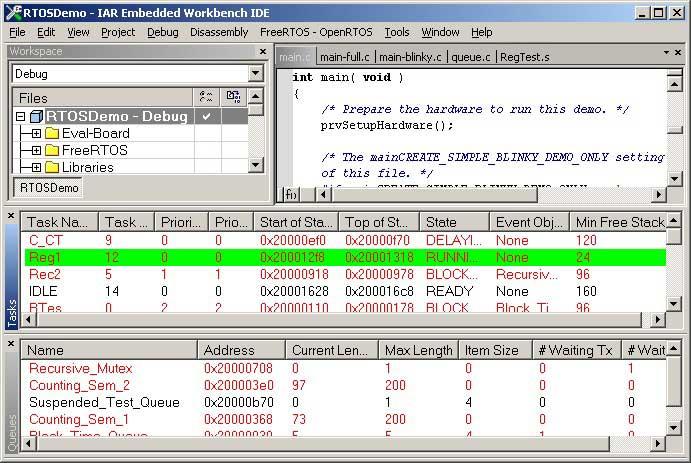
Note: If this project fails to build then it is likely the version of IAR Embedded Workbench being used is too old. If this is the case, then it is also likely that the project file has been (silently) corrupted and will need to be restored to its original state before it can be built even with an updated IAR version.
See also the FAQ My application does not run, what could be wrong?
The IAR EWARM workspace for the FreeRTOS STM32F0 demo application is called RTOSDemo.eww, and is located in the FreeRTOS/Demo/CORTEX_M0_STM32F0518_IAR directory. Note that the workspace was created prior to STM32F0 support being included in EWARM, and as such, the project is configured to use a generic ARM Cortex-M0 core, and the instructions provided on this page describe the separate ST-Link utility being used to program the microcontroller flash memory.
main_blinky() creates one queue, and two tasks. It then starts the scheduler.
The queue send task is implemented by the prvQueueSendTask() function in main_blinky.c. prvQueueSendTask() sits in a loop that causes it to repeatedly block for 200 milliseconds, before sending the value 100 to the queue that was created within main_blinky(). Once the value is sent, the task loops back around to block for another 200 milliseconds.
The queue receive task is implemented by the prvQueueReceiveTask() function in main_blinky.c. prvQueueReceiveTask() sits in a loop where it repeatedly blocks on attempts to read data from the queue that was created within main_blinky(). When data is received, the task checks the value of the data, and if the value equals the expected 100, toggles LED LD1. The 'block time' parameter passed to the queue receive function specifies that the task should be held in the Blocked state indefinitely to wait for data to be available on the queue. The queue receive task will only leave the Blocked state when the queue send task writes to the queue. As the queue send task writes to the queue every 200 milliseconds, the queue receive task leaves the Blocked state every 200 milliseconds, and therefore toggles LED LD1 every 200 milliseconds.
main_full() creates a set of standard demo tasks, some application specific test tasks, and a timer. It then starts the scheduler.
These fill the registers with known values, then check that each register maintains its expected value for the lifetime of the task. Each task uses a different set of values. The reg test tasks execute with a very low priority, so get preempted very frequently. A register containing an unexpected value is indicative of an error in the context switching mechanism.
The check software timer period is initially set to three seconds. Its callback function checks that all the standard demo tasks, and the register check tasks, are not only still executing, but are executing without reporting any errors. If the check timer callback discovers that a task has either stalled, or reported an error, then it changes the period of the check timer from the initial three seconds, to just 200ms. The callback function also toggles LED LD4 each time it is called. This provides a visual indication of the system status: If LED LD4 toggles every three seconds, then no issues have been discovered. If the LED toggles every 200ms, then an issue has been discovered with at least one task.
Note that portEND_SWITCHING_ISR() will leave interrupts enabled.
A dummy interrupt handler called Dummy_IRQHandler() is provided at the end of main.c as a reference implementation. Dummy_IRQHandler() is also replicated below.
void Dummy_IRQHandler(void)
{
long lHigherPriorityTaskWoken = pdFALSE;

    /* Clear the interrupt if necessary. */
    Dummy_ClearITPendingBit();

    /* This interrupt does nothing more than demonstrate how to synchronise a
    task with an interrupt.  A semaphore is used for this purpose.  Note
    lHigherPriorityTaskWoken is initialised to zero. Only FreeRTOS API functions
    that end in "FromISR" can be called from an ISR! */
    xSemaphoreGiveFromISR( xTestSemaphore, &lHigherPriorityTaskWoken );

    /* If there was a task that was blocked on the semaphore, and giving the
    semaphore caused the task to unblock, and the unblocked task has a priority
    higher than the current Running state task (the task that this interrupt
    interrupted), then lHigherPriorityTaskWoken will have been set to pdTRUE
    internally within xSemaphoreGiveFromISR().  Passing pdTRUE into the
    portEND_SWITCHING_ISR() macro will result in a context switch being pended to
    ensure this interrupt returns directly to the unblocked, higher priority,
    task.  Passing pdFALSE into portEND_SWITCHING_ISR() has no effect. */
    portEND_SWITCHING_ISR( lHigherPriorityTaskWoken );
}
Note that the following lines are included in FreeRTOSConfig.h.
	#define vPortSVCHandler      SVC_Handler
	#define xPortPendSVHandler   PendSV_Handler
	#define xPortSysTickHandler  SysTick_Handler
These definitions map the FreeRTOS kernel interrupt handler function names onto the CMSIS interrupt handler functions names - and in so doing, allow the ST or IAR provided linker scripts and start up files to be used without modification.
Attention please!: See the page dedicated to setting interrupt priorities on ARM Cortex-M devices. Remember that ARM Cortex-M cores use numerically low priority numbers to represent HIGH priority interrupts. This can seem counter-intuitive and is easy to forget! If you wish to assign an interrupt a low priority do NOT assign it a priority of 0 (or other low numeric value) as this will result in the interrupt actually having the highest priority in the system. Also, do not leave interrupt priorities unassigned, as by default they will have a priority of 0 and therefore the highest priority possible.
This sets the frequency of the RTOS tick interrupt. The supplied value of 1000Hz is useful for testing the RTOS kernel functionality, but is faster than most applications require. Lowering this value will improve efficiency.
Each port #defines 'BaseType_t' to equal the most efficient data type for that processor. This port defines BaseType_t to be of type long.
Note that vPortEndScheduler() has not been implemented.