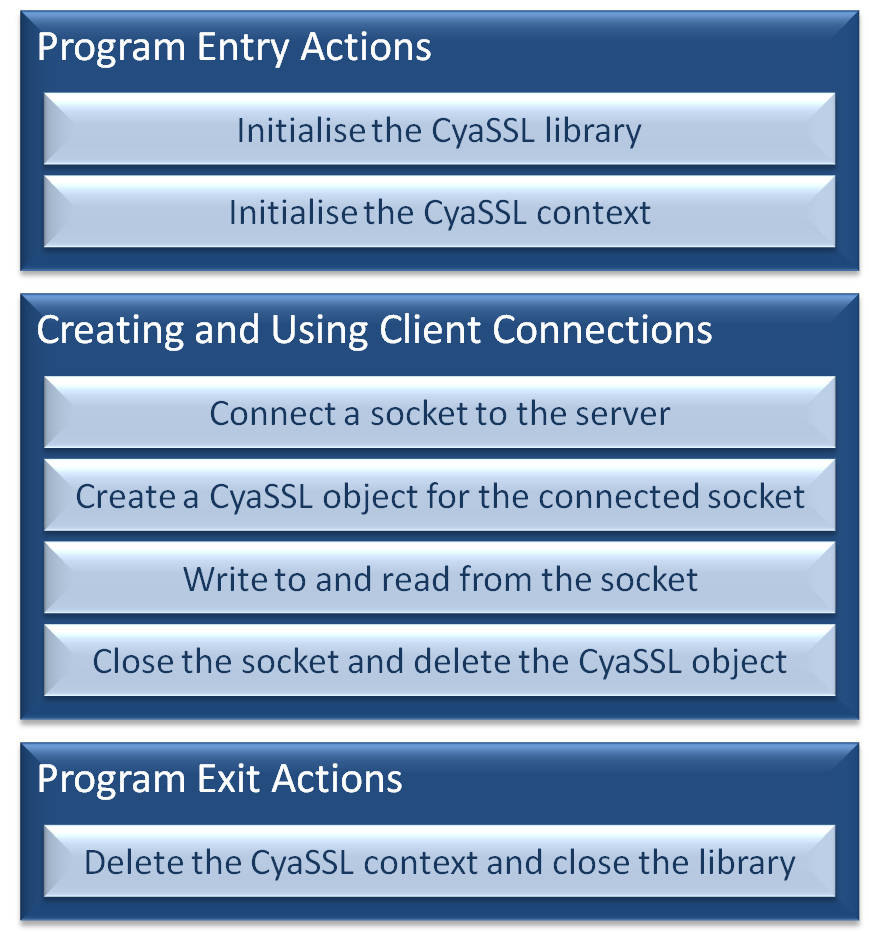
The three steps to using WolfSSL in a client side application
#include "wolfssl/ssl.h" The header file that must be included in all source files that use the WolfSSL library
Next, a variable of type WOLFSSL_CTX is required to store context information, and can be created using wolfSSL_CTX_new(). The SSL or TLS protocol to use is specified as the context is created using the function's parameter. Options include SSLv3, TLSv1, TLSv1.1, TLSv1.2, or DTLS. This example demonstrates the TLSv1 client protocol being selected. The values to use to select the other protocol options are listed in the user manual.
The final initialisation step is loading a Certificate Authority (CA) into the WolfSSL context. This allows authentication with the server the client will connect to. wolfSSL_CTX_load_verify_locations() is used for this purpose. In the example below, the first function parameter specifies the context into which the CA is loaded, and the second the CA certificate that is used. The third parameter can be used to specify a file path that will be searched for certificates, but in this case the file path is not necessary and so set to 0.
/* Define a structure to hold the WolfSSL context. */ WOLFSSL_CTX* xWolfSSL_Context; /* Initialise WolfSSL. This must be done before any other WolfSSL functions are called. */ wolfSSL_Init(); /* Attempt to create a context that uses the TLS V1 client protocol. */ xWolfSSL_Context = wolfSSL_CTX_new( CyaTLSv1_client_method() ); if( xWolfSSL_Context != NULL ) { /* Load the CA certificate. Real applications should ensure that wolfSSL_CTX_load_verify_locations() returns SSL_SUCCESS before proceeding. */ wolfSSL_CTX_load_verify_locations( xWolfSSL_Context, "ca-cert.pem", 0 ); } Library initialisation, protocol selection, and loading the CA certificate
WOLFSSL* xWolfSSL_Object; /* Standard Berkeley sockets connect function. */ if( connect( sockfd, (SA *) &servaddr, sizeof( servaddr ) ) == 0 ) { /* The connect was successful. Create a WolfSSL object to associate with this connection. The context created during initialisation is passed as the function parameter. */ xWolfSSL_Object = wolfSSL_new( xWolfSSL_Context ); if( xWolfSSL_Object != NULL ) { /* Associate the created WolfSSL object with the connected socket. */ wolfSSL_set_fd( xWolfSSL_Object, sockfd ); } } Creating a WolfSSL object, and associating it with a connected socket
Note that the first parameter to both wolfSSL_write() and wolfSSL_read() is not the socket descriptor, but the WolfSSL object that is associated with the socket descriptor.
char ucTxBuf[ MAXLINE ], ucRxBuf[ MAXLINE ]; if( wolfSSL_write( xWolfSSL_Object, ucTxBuf, strlen( ucTxBuf ) ) != strlen( ucTxBuf ) ) { /* Send failed. */ } if( wolfSSL_read( xWolfSSL_Object, ucRxBuf, MAXLINE ) <= 0 ) { /* Read failed. */ } Writing to and reading from a socket using the WolfSSL API
/* WolfSSL objects should be deleted when they are no longer required. */ wolfSSL_free( xWolfSSL_Object ); /* The WolfSSL context should be deleted if it is no longer required. However, because most deeply embedded applications will keep the context for the lifetime of the application, and only ever be restarted when the system is rebooted, it might be that the context is never explicitly freed. */ wolfSSL_CTX_free( xWolfSSL_Context ); /* The library itself should be shut down cleanly if it too is no longer required. Again, because most deeply embedded applications will require the library for the lifetime of the application, and only ever be restarted when the system is rebooted, it might be that the library is never explicitly closed. */ wolfSSL_Cleanup(); Deleting objects that were dynamically allocated in this example